
Miracle Leaf® Blog
What Is CBG? The Mother Cannabinoid, Explained
CBG, cannabigerol, is often called the mother cannabinoid because the plant makes THC, CBD, and others from its acid form. It does not produce a high. Most of what is claimed for it comes from lab and animal work, and the first controlled human trial, with 34 healthy adults, was published in 2024. Here is what CBG is, what the research actually measured, and what to know before buying it.
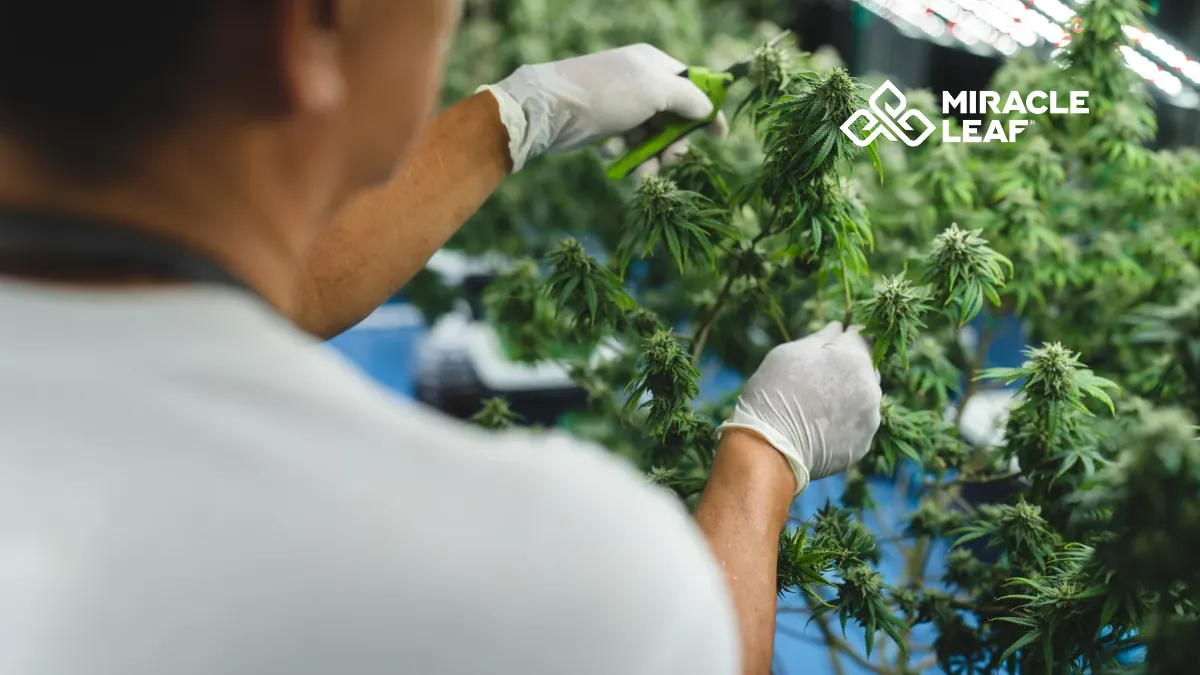
CBG, short for cannabigerol, is called the mother cannabinoid because the cannabis plant builds THC, CBD, and other cannabinoids from its acid form. It does not cause a high, and it is now sold in oils, gummies, and capsules, often with claims the research has not yet tested.
This post covers what CBG is, how it differs from CBD and THC, what the human evidence actually shows, and what to check before buying it.
What Is CBG?
CBG is one of more than 100 cannabinoids the cannabis plant produces. What makes it unusual is its place at the start of the chain.
The plant first makes cannabigerolic acid, CBGA. Enzymes then convert CBGA into the acid forms of the major cannabinoids, including THCA, the precursor of THC, and CBDA, the precursor of CBD. A 2021 review in the Journal of Pharmacology and Experimental Therapeutics by Nachnani, Raup-Konsavage, and Vrana describes CBG as the precursor from which the most abundant phytocannabinoids are synthesized.
Because most CBGA is converted as the plant matures, mature cannabis usually contains little CBG. Products high in CBG come from plants bred or harvested for it.
The THCA vs THC post covers the next step in the chain, where heat turns THCA into THC.
Does CBG Get You High?
The available human evidence says no.
The first controlled trial of CBG in people, published in Scientific Reports in 2024 by Cuttler, Stueber, Cooper, and Russo, gave 34 healthy adults 20 mg of hemp-derived CBG or a placebo tincture in two sessions a week apart. Neither the participants nor the researchers knew which was which. The study found no evidence of subjective drug effects or impairment from CBG.
That result applies to the dose tested. Higher doses, and products that also contain THC, may behave differently.
How Is CBG Different From CBD and THC?
All three come from the same plant, but they act on the body differently.
The Nachnani review describes CBG as having affinity and activity at the cannabinoid receptors that sits between THC and CBD. It also notes that CBG appears to be unique in its interactions with two other receptor families: alpha-2 adrenergic receptors, which affect blood pressure and alertness, and serotonin 5-HT1A receptors, which are involved in mood and anxiety.
The bigger difference is the evidence. CBD has years of human trials behind it and one FDA-approved prescription drug. The review notes that CBG is sold as a dietary supplement and that very little research has been done on this unregulated molecule compared with CBD.
What Does the Research Show About CBG?
Most of it comes from lab dishes and animals.
The Nachnani review summarizes preclinical work suggesting possible uses in neurological disorders and inflammatory bowel disease, as well as antibacterial activity. Preclinical results are a reason to study a compound in people, not evidence that it works in people.
The 2024 human trial. Cuttler and colleagues ran their study remotely, with participants taking the tincture at home and completing assessments over video. Compared with placebo, 20 mg of CBG:
- reduced overall self-reported anxiety
- reduced stress at the first assessment after dosing
- improved verbal memory, a secondary finding
The researchers concluded that CBG may be a novel option for reducing stress and anxiety in healthy adults. The limits are important: 34 participants, all healthy, one dose, self-reported measures, and a single study. It does not show that CBG treats an anxiety disorder.
For context on what the research supports for cannabis more broadly, the health benefits of medical cannabis post covers the stronger evidence base.
Is CBG Safe?
Short-term use at 20 mg produced no impairment in the 2024 trial, but long-term safety in people has not been studied. The Nachnani review covers CBG's potential toxicological risks and notes how little research exists.
One practical caution follows. Very little is known about how CBG interacts with prescription drugs, so tell your physician and pharmacist about any cannabinoid product you take. The cannabis drug interactions guide covers what is known for THC and CBD.
Will CBG Show Up on a Drug Test?
CBG is not what standard drug tests look for. The risk comes from THC.
Full-spectrum hemp products can carry trace delta-9 THC, and some CBG products are blends. The does CBD show up on a drug test post explains how trace THC in hemp products leads to positive results, and the same reasoning applies to CBG. Check the certificate of analysis for THC and THCA before buying.
Is CBG Legal?
CBG from hemp is sold under the federal hemp framework, and that framework changes on December 11, 2026.
Public Law 119-37, as delayed by Public Law 119-103, moves the federal standard from delta-9 THC alone to total tetrahydrocannabinols including THCA. It also excludes final hemp-derived cannabinoid products above 0.4 milligrams combined total per container. A CBG product's trace THC content is therefore more important after that date than before.
State hemp rules differ. The delta-8 vs delta-9 post links to the state-by-state articles for Florida, Georgia, and Texas.
What This Means for Florida, Georgia, and Texas Patients
Treat CBG as a supplement with limited evidence. It is not part of any state medical program's qualifying treatment, and no CBG product is approved for a medical condition.
Do not stop a prescribed treatment to try it. That includes anxiety medications. The 2024 trial studied healthy adults, not patients.
Bring the label to your visit. A physician can review the product, its THC content, and your other medications.
Miracle Leaf® physicians evaluate patients for the Florida, Georgia, and Texas programs. The qualifying conditions page covers eligibility in each.
What If You Live Outside Florida, Georgia, and Texas?
CBG research is the same everywhere, but hemp and medical cannabis rules are not. For an evaluation in another state where remote certification is permitted, see the Miracle Leaf® telehealth program.
Sources for CBG
- The Pharmacological Case for Cannabigerol. Nachnani R, Raup-Konsavage WM, Vrana KE. J Pharmacol Exp Ther. 2021;376:204 to 212. doi:10.1124/jpet.120.000340. PMID 33168643. Source of CBG as the precursor of the major cannabinoids, its receptor activity, the preclinical findings, and its status as an under-researched supplement.
- Acute effects of cannabigerol on anxiety, stress, and mood: a double-blind, placebo-controlled, crossover, field trial. Cuttler C, Stueber A, Cooper ZD, Russo E. Sci Rep. 2024;14:16163. doi:10.1038/s41598-024-66879-0. PMCID PMC11246434. Source of the 34-participant trial, the 20 mg dose, and the anxiety, stress, memory, and impairment findings.
- 7 U.S.C. 1639o. Federal hemp definition and the Public Law 119-37 amendment notes.
- Public Law 119-103. Delay of the federal hemp amendment to December 11, 2026.
Related Cannabinoid Resources
- The THCA vs THC post covers the cannabinoid CBG becomes in the plant.
- The delta-8 vs delta-9 post compares two THC isomers sold as hemp.
- The does CBD show up on a drug test post covers trace THC in hemp products.
- The health benefits of medical cannabis post covers the stronger evidence for cannabis.
- The cannabis drug interactions guide covers medication interactions.
Talk to a Physician About Cannabinoids
If you are weighing CBG, CBD, or a state medical program, a physician can go through the evidence with you. Call (833) LEGAL-MJ or contact us online to book. Pricing is on the pricing page.
Disclaimer
This post is informational and is not medical advice. Human research on CBG is limited to small studies, and the 2024 trial cited here studied healthy adults at a single dose. No CBG product is approved to diagnose, treat, or prevent any condition. Hemp products are not tested or regulated like state medical cannabis, and federal hemp law changes on December 11, 2026. Do not start, stop, or change a prescribed medication based on this article.
Common questions
Frequently asked questions
What is CBG?
Does CBG get you high?
What is CBG good for?
What is the difference between CBG and CBD?
Will CBG make you fail a drug test?
Is CBG legal?
Ready to talk with a Miracle Leaf® physician?
Reviewed by Miracle Leaf® Editorial Team. This article is for general education and is updated when the underlying law or clinical guidance materially changes.