
Miracle Leaf® Blog
Saliva Drug Tests and Cannabis: What They Detect
A saliva drug test looks for a different molecule than a urine test, in a different place, for a different reason. It detects parent THC deposited in the mouth during smoking rather than the metabolite your liver produces. The widely repeated answer of 12 to 24 hours is not what the controlled research found. In one study, occasional users fell below the federal cutoff by about 32 hours, while frequent users were still above it at 72 hours when the study ended. Here is what oral fluid testing actually measures, what the federal rules say, and why a positive result does not establish impairment.
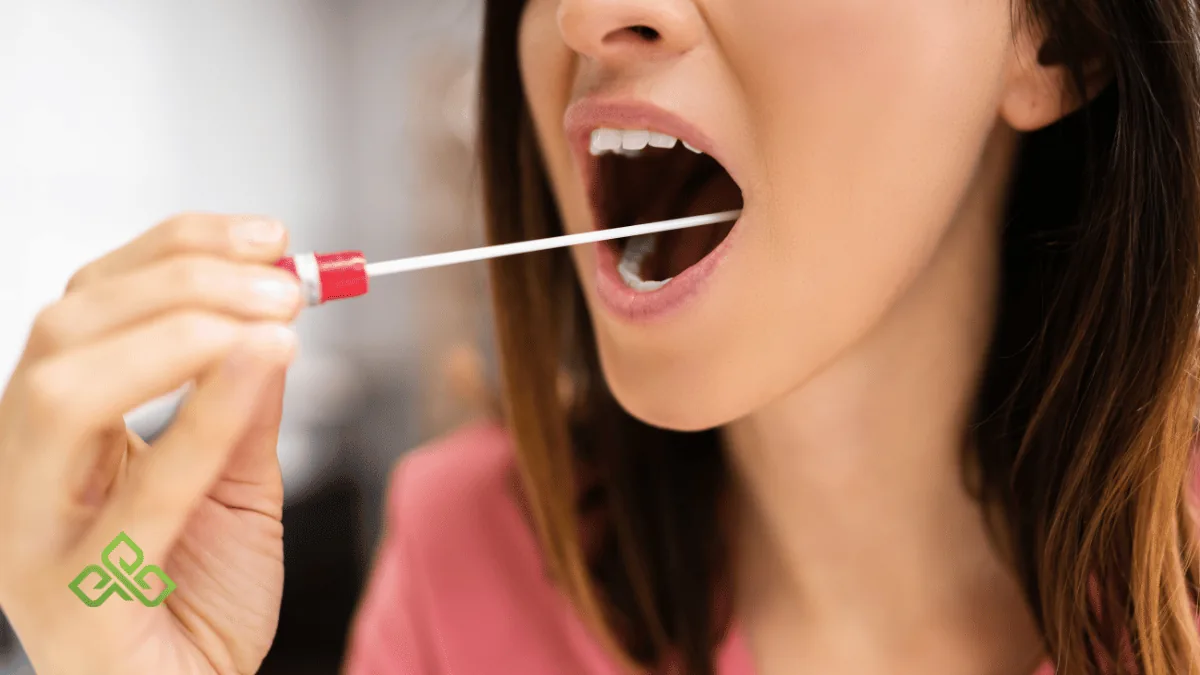
Ask how long weed stays in your saliva and most sources give a single confident number, usually somewhere between 12 and 24 hours. The controlled research does not support one number, and for frequent users it does not support that range either. A saliva drug test measures something different from a urine test, in a different place, for a different reason. It looks for THC itself, deposited in your mouth as you smoke, and that one mechanical fact explains nearly every surprising result below.
How Long Does Weed Stay in Your Saliva?
Longer than the common answer, and the honest version depends on how often you use cannabis.
The most directly relevant evidence is a controlled study of smoked, vaporized, and oral cannabis. It measured 1,102 oral fluid specimens from 11 frequent users and 9 occasional users, each dosed with roughly 50.6 mg of THC. Measured against the 2 ng/mL federal confirmatory cutoff:
- Occasional users fell below the cutoff by about 32 hours.
- Frequent users were still positive at 72 hours, when the collection period ended. One frequent user tested at 2.2 ng/mL on discharge, three days after smoking.
A separate controlled smoking study of 14 frequent and 10 occasional users, using a more sensitive 1 ng/mL research threshold, found median last positive times of 28 hours for frequent users and 21 hours for occasional users.
Two things follow from that, and both cut against the usual advice. The window is not one day for everyone, and the frequent-user tail is genuinely open ended, because the study stopped before those participants did. Anyone quoting a precise number for your body is guessing, and the study authors do not make that claim about their own data.
What Does a Saliva Drug Test Actually Detect?
Parent THC, not the metabolite a urine test looks for. That single difference drives almost everything else about the test.
A standard urine test targets a carboxy metabolite your liver produces while breaking THC down. Oral fluid testing targets delta-9 tetrahydrocannabinol itself, the parent compound. Because the parent compound clears faster than the metabolite it becomes, oral fluid is generally treated as an indicator of more recent use.
The terminology is worth untangling, because the search term and the regulation do not match. Everyone says "saliva test." Federal regulations and the research literature say oral fluid. The reason is that a collection device gathers saliva mixed with material from the oral mucosa. As the next section explains, that second part is doing most of the work.
Why Does THC End Up in Saliva at All?
Not the way most people assume. It is mostly deposited directly, not delivered by your bloodstream.
The comprehensive review of oral fluid drug testing by Cone and Huestis states the finding plainly: THC is present in oral fluid primarily as a result of deposition in the oral cavity, rather than from transfer from blood. When cannabis smoke passes through the mouth, it coats the oral mucosa, and the test largely measures that residue.
This is not a technicality. It explains nearly every counterintuitive result in this article:
- It explains why oral fluid concentrations immediately after smoking can be far higher than blood concentrations at the same moment.
- It explains why the route of administration matters so much, since a route that never puts smoke in your mouth deposits far less.
- It explains why oral fluid THC tracks blood THC poorly at the individual level, which is the subject of the impairment section below.
A saliva test is, to a significant degree, sampling what recently passed through your mouth.
What Are the Federal Saliva Test Cutoff Levels?
Federal oral fluid cutoffs are set far lower than urine cutoffs, because the target molecule is present at much lower concentrations.
For Department of Transportation regulated testing, 49 CFR section 40.91 sets the oral fluid thresholds for marijuana:
| Test stage | Analyte | Cutoff |
|---|---|---|
| Initial (screen) | Marijuana (THC) | 4 ng/mL |
| Confirmatory | THC | 2 ng/mL |
A result below the cutoff is reported as negative even when the substance is present. Research papers in this field often report concentrations in micrograms per liter, which is the same unit: 1 ug/L equals 1 ng/mL. That matters when comparing study figures against the numbers above.
Our post on how long THC stays in your system covers the urine cutoffs and the general detection-window question, including why the widely repeated 30 day figure is poorly supported. This article does not restate that analysis.
Can You Actually Be Given a DOT Saliva Test Right Now?
Almost certainly not, and this is the part of the topic most sources get wrong or report as of a date years out of step.
The Department of Transportation published a final rule on May 2, 2023 at 88 FR 27596, effective June 1, 2023, adding oral fluid testing to its regulated drug testing program. That rule carries a condition: "In order for an employer to implement oral fluid testing there must be at least two HHS-certified laboratories for oral fluid testing."
That condition has still not been met. The Department of Health and Human Services publishes a list of certified laboratories in the Federal Register, and the notice published August 3, 2026 at 91 FR 48907 states it directly: "At this time, there are no laboratories certified to conduct drug and specimen validity tests on oral fluid specimens."
So the framework exists and the infrastructure does not. Federally regulated oral fluid testing has been authorized on paper for over three years without a single certified laboratory to perform it. Private employers outside the federal program are a separate matter, operating under state law and their own policies rather than under this rule. But a commercial driver reading that DOT now permits saliva testing should understand that it is not currently being performed under that program.
One operational detail from the same rule explains why employers wanted the option: "All oral fluid collections are directly observed because they are always collected in front of the collector." The rule frames that as a way to combat cheating on urine drug tests. It also frames it as far less intrusive on privacy than a directly observed urine collection, which is the alternative it replaces.
Do Edibles Show Up on a Saliva Test?
Much less reliably than smoking does, and the deposition mechanism is exactly why.
The Cone and Huestis review reports that following ingestion of hemp oil liquid containing THC and capsules of dronabinol, positive oral fluid tests for THC did not occur. Nothing passed through the mouth as smoke, so nothing was deposited there.
The controlled comparison study bears this out with numbers. Mean peak oral fluid THC concentrations in frequent users differed enormously by route:
| Route | Mean peak oral fluid THC | Range |
|---|---|---|
| Smoked | 2,789 ng/mL | 141 to 8,503 |
| Vaporized | 1,874 ng/mL | 68.6 to 7,373 |
| Oral (brownie) | 297 ng/mL | 16.5 to 938 |
The oral dose produced roughly a tenth of the peak concentration of the smoked dose, from the same quantity of THC, and detection rates dropped more quickly after oral administration.
Read that carefully, because it is not a claim that edibles are undetectable. The oral route still produced measurable oral fluid THC well above the 2 ng/mL cutoff, and some of that is explained by the product passing through the mouth on the way down. What the data show is that oral fluid testing is substantially less sensitive to non-smoked routes when measuring parent THC, which is a real limitation of the method rather than a strategy.
The same study found the opposite pattern for metabolites, which is worth stating because it complicates the simple version. In occasional users, oral dosing produced more metabolite-positive specimens than the inhaled routes did, widening the metabolite detection window after edibles rather than narrowing it. Federal oral fluid cutoffs target parent THC, so this does not change the cutoff analysis above, but it does mean that "edibles clear oral fluid faster" is too blunt a summary to be accurate.
Does a Positive Saliva Test Prove Impairment?
No, and the best available evidence says so in unusually direct terms.
A 2022 systematic review in Accident Analysis and Prevention pooled individual-level data from paired oral fluid and blood samples, finding THC concentrations measured in over 18,000 paired samples. Its findings split cleanly in two:
- On whether THC is present at all, agreement was good: sensitivity 71.2 percent and specificity 97.7 percent for detecting the presence of THC in blood.
- On whether blood THC exceeded a per se limit such as 5 ng/mL, oral fluid THC at commonly used cutoffs was less sensitive and less specific.
The authors' conclusion is worth quoting rather than paraphrasing. They wrote that there would be "a large number of false positive tests if oral fluid THC testing were used as a biomarker for illegal THC concentrations in randomly selected drivers," and recommended against oral fluid THC screening in randomly selected drivers in jurisdictions with non-zero per se blood THC limits. They drew a distinction in the other direction as well: oral fluid tests "appear to be useful for investigating high-risk drivers who come to police attention because of evidence of impairment."
That distinction is the substance of the finding. Oral fluid testing is a reasonable tool for confirming recent use in someone already showing signs of impairment. It is a poor tool for establishing impairment in someone who is not.
Where Are Saliva Tests Actually Used?
Two settings, with different purposes and different consequences.
Roadside. A number of states have adopted roadside oral fluid screening. The North Carolina Criminal Law blog at the UNC School of Government describes the role most of them assign it: a roadside test that "aids law enforcement in determining whether probable cause exists for impaired driving." It notes that this testing "has not replaced the work of Drug Recognition Experts." Instead it has mostly helped officers who are not Drug Recognition Experts decide whether to arrange such an evaluation. State law varies considerably on whether and how results may be used. That is a question for an attorney licensed in your state rather than for an article.
Workplace. Outside the federally regulated program described above, private employers set their own testing policies within the limits of state law. The attraction of oral fluid for an employer is the observed collection, and the shorter window is sometimes presented as better aligned with recent use, though the frequent-user data above complicate that claim.
What About CBD Products and Detection Windows Generally?
Both are covered in full elsewhere on this site, and the short version here is a pointer rather than a summary.
If your question is whether a CBD product could produce a positive result, the relevant issue is undisclosed THC content in products sold as CBD, not CBD itself. Our post on whether CBD shows up on a drug test covers the controlled dosing studies, the labeling accuracy research, and the federal hemp definition.
If your question is about detection windows generally, particularly urine testing and the factors that change an individual result, our post on how long THC stays in your system covers that ground.
This article does not offer guidance on influencing a test result, and no reputable clinical source does. Detection science exists so that results can be interpreted accurately. That is the appropriate use of it, and it is the reason the numbers above are presented with their study populations and limits attached rather than as a countdown.
What This Means for Florida, Georgia, and Texas Patients
Certification and testing are separate systems, and the gap between them causes most of the trouble we see at appointments.
A registry card does not shield you from a positive test. Florida, Georgia, and Texas are all at-will employment states, and none of their medical cannabis programs adds employment protection for registered patients. A state credential does not modify federal testing rules or private employer policy. The CDL and medical marijuana post covers the federal framework and the medical review officer rule for commercial drivers.
Ask what your employer actually tests, and when. Oral fluid, urine, and hair are different tests with different windows and different targets, and a policy that specifies one does not imply the others. If your employer is federally regulated, the certified-laboratory gap described above is directly relevant to what they can currently do.
Raise it at the appointment rather than after a result. Whether certification fits your employment situation is a reasonable thing to work through with a physician before you enroll. It sometimes changes the recommendation.
Using cannabis is not itself a qualifying condition. Eligibility runs off each state published condition list. The qualifying conditions page covers the Florida list, and the Georgia and Texas pages cover those programs. The three state programs are covered on the Florida, Georgia, and Texas program pages, and the statutory framework for each on the Florida marijuana laws, Georgia marijuana laws, and Texas marijuana laws pages.
If You Live Outside Florida, Georgia, or Texas
The pharmacology above does not change by state, but your certification options do.
Miracle Leaf® operates clinics in Florida, Georgia, and Texas. If you live elsewhere, the telehealth hub covers the states served by telehealth evaluation. It links to a page for each one with that state eligibility rules.
Sources for Saliva and Oral Fluid Cannabis Testing
- Cannabinoid disposition in oral fluid after controlled smoked, vaporized, and oral cannabis administration. Swortwood MJ, Newmeyer MN, Andersson M, Abulseoud OA, Scheidweiler KB, Huestis MA. Drug Testing and Analysis 2017;9(6):905 to 915. doi:10.1002/dta.2092. PMID 27647820, PMCID PMC5357602. Source for the 32 hour occasional and 72 hour frequent figures at the 2 ng/mL cutoff and for the route-of-administration peak concentrations.
- Cannabinoid disposition in oral fluid after controlled cannabis smoking in frequent and occasional smokers. Newmeyer MN, Desrosiers NA, Lee D, Mendu DR, Barnes AJ, Gorelick DA, Huestis MA. Drug Testing and Analysis 2014;6(10):1002 to 1010. doi:10.1002/dta.1632. PMID 24652685, PMCID PMC4169757. Source for the 28 hour and 21 hour median last positive times at the 1 ng/mL research threshold.
- Interpretation of Oral Fluid Tests for Drugs of Abuse. Cone EJ, Huestis MA. Annals of the New York Academy of Sciences 2007;1098:51 to 103. doi:10.1196/annals.1384.037. PMID 17332074, PMCID PMC2700061. Source for oral cavity deposition as the primary route into oral fluid and for the dronabinol and hemp oil ingestion result.
- Correlation between oral fluid and blood THC concentration: A systematic review and discussion of policy implications. Robertson MB, Li A, Yuan Y, Jiang A, Gjerde H, Staples JA, Brubacher JR. Accident Analysis and Prevention 2022;173:106694. doi:10.1016/j.aap.2022.106694. PMID 35640367. Source for the over 18,000 paired samples, the 71.2 percent sensitivity and 97.7 percent specificity figures, and the recommendation against screening randomly selected drivers.
- Nonsmoker Exposure to Secondhand Cannabis Smoke. III. Oral Fluid and Blood Drug Concentrations and Corresponding Subjective Effects. Cone EJ, Bigelow GE, Herrmann ES, Mitchell JM, LoDico C, Flegel R, Vandrey R. Journal of Analytical Toxicology 2015;39(7):497 to 509. doi:10.1093/jat/bkv070. PMID 26139312. Source for the passive exposure chamber study and the 3 hour figure.
- 49 CFR section 40.91. Federal regulation setting oral fluid drug test cutoff concentrations for Department of Transportation testing, at 4 ng/mL initial and 2 ng/mL confirmatory for marijuana.
- Procedures for Transportation Workplace Drug and Alcohol Testing Programs, 88 FR 27596. Department of Transportation final rule published May 2, 2023, effective June 1, 2023. Source for the two-laboratory precondition and the directly observed collection language.
- Current List of HHS-Certified Laboratories, 91 FR 48907. Substance Abuse and Mental Health Services Administration notice published August 3, 2026. Source for the statement that no laboratories are certified for oral fluid testing, and for the October 10, 2023 effective date of the Oral Fluid Mandatory Guidelines.
- Developments in Roadside Drug Testing. Elrahal B. UNC School of Government North Carolina Criminal Law blog, April 1, 2026. Source for the screening and probable cause role of roadside oral fluid testing.
Related Drug Testing and Compliance Resources
- The how long does THC stay in your system post covers urine detection windows, the federal cutoff concentrations, and the factors that change an individual result.
- The does CBD show up on a drug test post covers CBD versus THC test behavior, product labeling accuracy, and the federal hemp definition.
- The CDL and medical marijuana post covers federal Department of Transportation testing, the medical review officer rule, and return-to-duty procedures.
- The probation and medical marijuana post covers court-ordered testing considerations.
- The firearms and medical marijuana post covers the federal framework for registered patients.
- Your medical card and your job covers whether a positive test can cost you your job, which depends on your state.
- The qualifying conditions page covers eligibility across the state programs.
Talk to a Physician About Your Certification Options
Miracle Leaf® physicians evaluate patients for state medical cannabis programs in Florida, Georgia, and Texas, and whether certification fits your work situation is part of that conversation. If you are subject to workplace testing, or you hold a commercial driver license or another safety-sensitive role, raise it at the appointment. It changes the advice.
Call (833) LEGAL-MJ or contact us online to book. Evaluation pricing is on the pricing page.
Disclaimer
This post is informational and is not medical or legal advice, and it is not guidance for influencing a drug test result. The detection figures cited here come from small controlled research populations dosed under laboratory conditions and do not predict results for any individual, any product, or any use pattern. Detection windows depend on the cutoff concentration used, the collection device, the route of administration, and frequency of use, and published averages describe populations rather than people. Federal oral fluid testing requirements are governed by 49 CFR Part 40, and the availability of federally regulated oral fluid testing depends on laboratory certification status that changes over time. State law governing roadside oral fluid testing varies and is outside the scope of this article. State medical cannabis registration does not create employment protection in Florida, Georgia, or Texas and does not affect federal testing requirements. Consult a licensed physician about clinical questions, and an attorney about workplace or roadside testing exposure specific to your situation.
Common questions
Frequently asked questions
How long does weed stay in your saliva?
What does a saliva drug test detect?
How does THC get into saliva in the first place?
Do edibles show up on a saliva drug test?
Can I be given a DOT saliva drug test right now?
Does a positive saliva test prove someone is impaired?
Can secondhand smoke cause a positive saliva test?
Does a medical marijuana card protect me from a positive saliva test?
Ready to talk with a Miracle Leaf® physician?
Reviewed by Miracle Leaf® Editorial Team. This article is for general education and is updated when the underlying law or clinical guidance materially changes.