
Miracle Leaf® Blog
Is Delta-8 or Delta-9 THC Legal in Georgia?
Hemp-derived delta-9 products are legal in Georgia for adults 21 and older if they stay at or below 0.3 percent total delta-9 THC and within the Department of Agriculture serving limits. Delta-8 is a different story: Georgia hemp law never names it, so the statute does not settle its status. THCA flower cannot be sold at retail. None of this touches the medical cannabis program, which runs on a separate law. And on December 11, 2026, a new federal hemp definition takes effect on top of all of it.
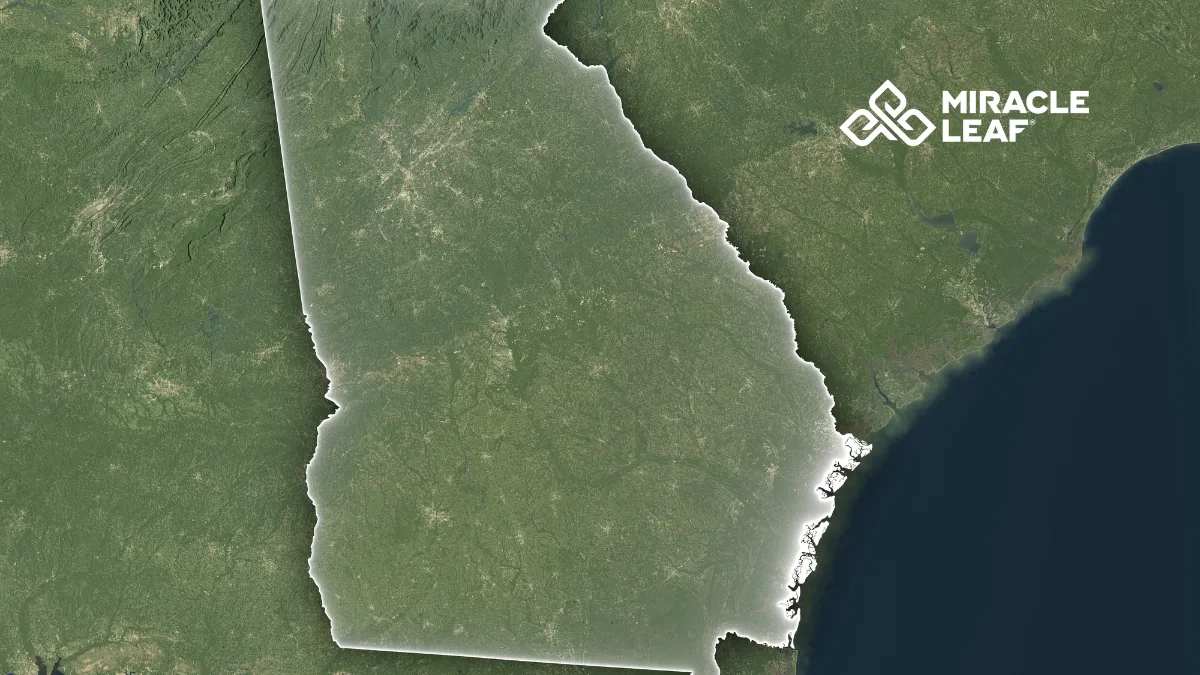
Hemp-derived delta-9 is legal in Georgia within strict limits, delta-8 sits in a gap the statute never closed, and THCA flower cannot be sold at retail. The medical cannabis program is a separate system entirely.
What follows covers each compound, the product limits that apply to gummies and drinks, what Georgia did and did not change in 2026, and what the federal hemp redefinition on December 11, 2026 adds. For the Georgia medical program itself, see the Georgia marijuana laws page.
Is Delta-8 Legal in Georgia?
Georgia law does not name delta-8. The Georgia Hemp Farming Act measures hemp products by total delta-9 THC, and the statute text does not settle where delta-8 stands. Treat it as unresolved, and expect the federal change on December 11, 2026 to reach most delta-8 products.
The gap comes from how the law is written. Georgia defines hemp at O.C.G.A. 2-23-3, as amended by SB 494, as the plant "and any part of such plant, including the seeds thereof and all derivatives, extracts, cannabinoids, isomers, acids, salts, and salts of isomers," with "a total delta-9-THC concentration that does not exceed the legal limit." Delta-8 is an isomer of delta-9, and the only THC the definition measures is delta-9 and its acid.
That wording explains why delta-8 is still sold in Georgia. It does not make delta-8 clearly lawful. No Georgia statute addresses converted cannabinoids, and the question has not been settled by the text. Consult a Georgia attorney before relying on a specific product.
The federal side is clearer. Most delta-8 on the market is made by chemically converting hemp CBD, which the FDA describes as the typical manufacturing route. The new federal hemp definition, covered below, excludes cannabinoids "synthesized or manufactured outside the plant."
Is Delta-9 THC Legal in Georgia?
Hemp-derived delta-9 is legal for adults 21 and older when a product stays at or below 0.3 percent total delta-9 THC and within the Department of Agriculture product limits. Delta-9 from marijuana, outside the medical program, is not.
The 0.3 percent figure is a concentration by dry weight, not a dose. That is why the state added milligram limits by product type in rules that took effect January 8, 2025. A product can satisfy the percentage and still break a milligram cap, or the reverse.
How Georgia Measures Total Delta-9 THC
Under O.C.G.A. 2-23-3.1, added by SB 494, a lab establishes delta-9 THC concentration one of two ways:
- Testing a sample after decarboxylation, so all THCA has been converted to delta-9 THC, or
- Adding the percentage of THCA multiplied by 0.877 to the percentage of delta-9 THC.
The "legal limit" is the lesser of 0.3 percent or the percentage limit set in the federal hemp definition at 7 U.S.C. 1639o. Both methods count THCA, which is what makes the difference for flower.
How Much Delta-9 Can a Gummy or Drink Have in Georgia?
Georgia Department of Agriculture Rule 40-32-5-.06, adopted December 19, 2024 and effective January 8, 2025, sets maximums for consumable hemp products in final packaged form:
| Product | Total delta-9 THC limit |
|---|---|
| Gummy | 10 mg per gummy, 300 mg per package |
| Beverage | 10 mg per 12 fluid ounces, container no larger than 12 ounces |
| Tincture | 2 mg per milliliter, container no larger than 60 milliliters |
| Topical | 1,000 mg per package |
Those limits are written in terms of total delta-9 THC. Like the statute, they do not name delta-8.
Is THCA Flower Legal in Georgia?
Not at retail, for two independent reasons.
THCA counts toward the limit. Because Georgia multiplies THCA by 0.877 and adds it to delta-9, high-THCA flower tests well above 0.3 percent total delta-9 THC and falls outside the hemp definition.
Retail flower sales are barred outright. SB 494 amended O.C.G.A. 2-23-4 to make it unlawful for any person "to offer for sale at retail the unprocessed flower or leaves of the hemp plant," "regardless of the total delta-9-THC concentration" in it. The same provision states that it does not prohibit the sale of hemp products made from extracts or derivatives of the flower or leaves.
So a low-THC hemp flower is barred at retail too, while an extract made from flower can be sold if it meets the other limits.
How Old Do You Have to Be to Buy Hemp THC in Georgia?
- SB 494 added O.C.G.A. 16-12-241, which makes it unlawful to "sell, furnish, or cause to be furnished" a consumable hemp product to anyone under 21, and unlawful for anyone under 21 to purchase or possess one. Sellers must check identification. The rule covers consumable hemp products generally, CBD included.
Did Georgia Ban Delta-8 or Hemp THC in 2026?
No. Several bills tried, and none became law. Georgia hemp law still rests on SB 494 and the Department of Agriculture rules.
SB 33 is the source of most of the confusion. It was introduced in 2025 as an amendment to the Georgia Hemp Farming Act to limit total THC in consumable hemp products, and a House committee substitute in 2026 added provisions on synthetic cannabinoids. A Senate floor amendment then replaced the bill's text with property tax provisions. The version that passed both chambers and was signed on May 11, 2026 as Act 461 is the "Homeownership Opportunity and Market Equalization Act of 2026" and contains no hemp provisions, according to the bill record on the Georgia General Assembly site. The bill's listed title still reads "Georgia Hemp Farming Act," which is how secondary summaries came to describe it as a hemp law.
SB 254, which would have set milligram limits for delta-9 in consumable hemp products, was reported by substitute out of a House committee and did not pass. Other hemp bills introduced in the session did not advance.
What Changes Federally on December 11, 2026?
Federal law changes the definition of hemp, and that applies in Georgia regardless of what state law says.
Public Law 119-37, enacted November 12, 2025, amends the federal hemp definition at 7 U.S.C. 1639o. Public Law 119-103, signed September 2, 2026, delayed most of it to December 11, 2026. The changes that matter for the products in this article:
- The standard becomes total tetrahydrocannabinols, including THCA, rather than delta-9 alone.
- Cannabinoids not capable of being naturally produced by the plant, and cannabinoids synthesized or manufactured outside the plant, are excluded. The first of these exclusions took effect November 12, 2026.
- Final hemp-derived cannabinoid products are excluded above 0.4 milligrams combined total per container.
The Congressional Research Service confirms the November 12 and December 11 effective dates.
Set against Georgia's rules, item 3 is the largest change. Georgia allows 10 milligrams per gummy and 300 milligrams per package. The federal ceiling for a final product is 0.4 milligrams per container. A product excluded from the federal hemp definition is no longer federal hemp, whatever Georgia's own definition says, and how state enforcement responds is an open question. The Florida and Texas articles cover how the same federal change lands in those states.
Does the Hemp Law Affect the Georgia Medical Cannabis Program?
No. The two systems run on different statutes, different agencies, and different supply chains.
Hemp products fall under O.C.G.A. Title 2, Chapter 23, and the Georgia Department of Agriculture. The medical program rests on O.C.G.A. 31-2A-18 and the Department of Public Health registry, renamed the Medical Cannabis Patient Registry by SB 220, effective July 1, 2026. Registered patients buy medical cannabis from licensed dispensaries, not hemp retailers, and the federal hemp redefinition does not change the medical program.
The is medical marijuana legal in Georgia post covers what SB 220 changed for patients.
What This Means for Georgia Patients
If a qualifying condition is the reason you buy hemp THC, look at the medical program. It is regulated, it runs on a different statute, and the December 11 federal change does not reach it. The Georgia qualifying conditions page lists the registry conditions.
Do not assume a hemp product will look the same after December 11. Georgia's 10 milligram gummy and the federal 0.4 milligram container ceiling cannot both describe the same product.
A certificate of analysis is the seller's evidence, not a safe harbor. It reflects the seller's testing. It does not settle whether a product meets the definition if it is tested again.
Hemp THC shows up on drug tests. A hemp delta-9 or delta-8 product produces the same metabolite as any other THC. The how long does THC stay in your system post covers detection.
Miracle Leaf® physicians evaluate patients for the Georgia program, as well as in Florida and Texas.
What If You Live Outside Georgia?
Hemp law differs sharply between states. Florida keeps a percentage-only definition and Texas has moved delta-8 into Schedule I, while the federal change applies everywhere. For a medical cannabis evaluation in another state where remote certification is permitted, see the Miracle Leaf® telehealth program.
Sources for Georgia Hemp and Cannabinoid Law
Statutes, rules and bill records were read directly. Retrieved November 4, 2026.
- Georgia SB 494 (2024), signed text. Amends the Georgia Hemp Farming Act: hemp definition and legal limit at O.C.G.A. 2-23-3, total delta-9 THC measurement at 2-23-3.1, the retail flower and leaf bar at 2-23-4, the under-21 provisions at 16-12-241, and the October 1, 2024 effective date for most sections.
- Georgia Department of Agriculture Rules, Subject 40-32-5, Consumable Hemp Products. Rule 40-32-5-.06, Serving Sizes and Serving Limits, adopted December 19, 2024, effective January 8, 2025.
- Georgia SB 33 (2025 to 2026 session), bill record. Georgia General Assembly. Version history including the House committee substitute, Senate Floor Amendment 3, and the as-passed text; signed May 11, 2026 as Act 461.
- Georgia SB 254 (2025 to 2026 session), bill record. Georgia General Assembly. Milligram limits for delta-9 in consumable hemp products; last action House Committee Favorably Reported by Substitute.
- 5 Things to Know about Delta-8 Tetrahydrocannabinol. U.S. Food and Drug Administration. Source of the statement that concentrated delta-8 is typically manufactured from hemp-derived CBD.
- 7 U.S.C. 1639o. Current federal hemp definition and the Public Law 119-37 amendment notes.
- Public Law 119-103. Division B, section 2019, delaying most of the federal hemp redefinition to December 11, 2026.
- Changes to the Statutory Definition of Hemp and Implications for Agricultural Policy. Congressional Research Service In Focus IF13136, updated September 28, 2026.
Related Georgia Cannabis Law Resources
- The Georgia marijuana laws page covers the medical program, possession penalties, and the hemp summary.
- The is medical marijuana legal in Georgia post covers SB 220 and the registry process.
- The Georgia qualifying conditions page lists the registry conditions.
- The delta-8, delta-9, and THCA in Florida post covers the same compounds under Florida law.
- The Texas hemp ban 2026 post covers the Texas Schedule I action on delta-8.
Talk to a Physician About the Georgia Medical Program
If you have been buying hemp THC in Georgia for a qualifying condition, the medical program is worth understanding before December 11. Call (833) LEGAL-MJ or contact us to book an evaluation. Pricing is on the pricing page.
Disclaimer
This post is informational and is not legal or medical advice. It describes Georgia statutes, rules, and bill records as they read on November 4, 2026, and the federal effective dates as set by Public Law 119-103. Georgia hemp law does not name delta-8, and its status under state law is unsettled rather than clearly lawful. How Georgia enforcement will treat products that meet state limits but fall outside the federal definition after December 11, 2026 is not yet known. A certificate of analysis reflects a seller's testing and is not a legal safe harbor. Nothing here authorizes possession of any product. Eligibility for the Georgia medical cannabis program is determined by a licensed physician against the state registry condition list. Consult a licensed Georgia attorney about your own legal exposure.
Common questions
Frequently asked questions
Is delta-8 legal in Georgia?
Is delta-9 THC legal in Georgia?
How much delta-9 can a hemp gummy or drink have in Georgia?
Is THCA flower legal in Georgia?
How old do you have to be to buy delta-8 or delta-9 in Georgia?
Did Georgia ban delta-8 or hemp THC in 2026?
Does the hemp law affect the Georgia medical cannabis program?
Ready to talk with a Miracle Leaf® physician?
Reviewed by Miracle Leaf® Editorial Team. This article is for general education and is updated when the underlying law or clinical guidance materially changes.